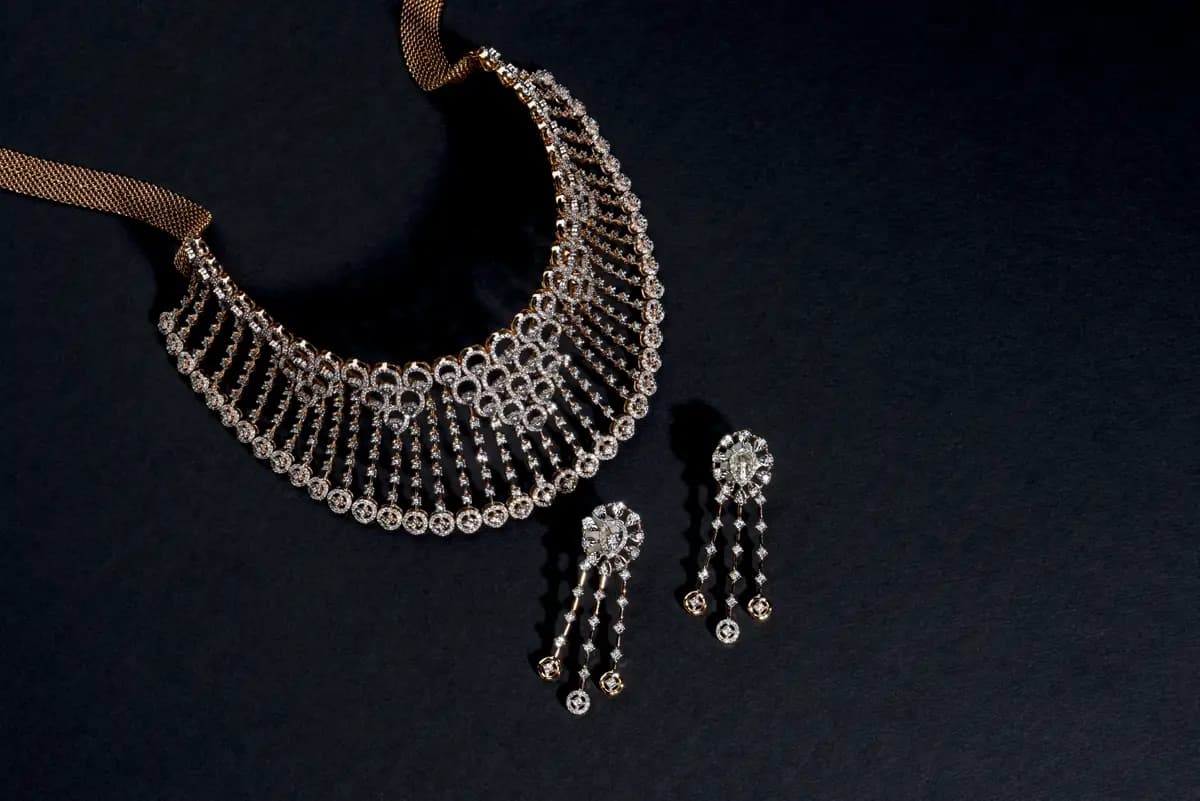
What Brilliance Actually Is
When a diamond catches the light and scatters it into a spectrum of colour across the wall, what you are seeing is total internal reflection at work. Light enters the stone, strikes the pavilion facets at precisely the right angle, and bounces back out through the table — the flat top surface — in a cascade of white and coloured light. The cutter's job is to angle every single facet so that as much light as possible follows this path.
A poorly cut diamond leaks light through its base. You can see one immediately: it looks glassy, flat, almost dull. A well-cut diamond — like the rounds in Mila's Hessa collection — seems to generate its own light from within. The stone glows even in dim conditions. That is not magic. That is decades of refinement in cutting geometry.
The Four Cs, Reconsidered
Every jeweller will explain the four Cs to you: cut, colour, clarity, carat. What they sometimes forget to say is that these four properties are not equal. Cut is the most important by a wide margin. A flawless, perfectly colourless diamond with a poor cut will look worse than a slightly included, lightly tinted stone with an excellent cut. Light performance is everything.
Colour comes second, particularly in larger stones where colour becomes more visible to the naked eye. Clarity, for most practical purposes, matters only when inclusions are eye-visible — and most stones in the VS clarity range are perfectly beautiful in practice. Carat weight, contrary to popular belief, is the least important factor when choosing a diamond. A 0.90 carat stone with excellent cut, G colour, and VS1 clarity will look more impressive than a 1.10 carat stone with mediocre cut.
The Hessa Standard
Mila's Hessa collection was built around a single obsession: light. Every diamond selected for Hessa pieces undergoes light performance testing before it is approved for setting. The goal is simple — every stone should make the person wearing it look radiant, in any light, at any time of day.
A diamond does not merely reflect light. It transforms it — breaking white light into its component colours and returning it to the world as something more beautiful than it arrived.
There is a reason diamonds have been associated with eternity across almost every culture on Earth. Long before the science was understood, people simply knew: this stone does something no other material does. It takes what the world gives it and makes it more.